[Written March 2019]
Seaweed Climate Superhero?
We know that human caused greenhouse gas emissions, such as methane, are warming our planet. Animal agriculture is responsible for more emissions than all transport, including aviation, combined. This is largely because of the enteric methane emissions from livestock as methane as a greenhouse gas is 28 times more potent than carbon dioxide. Reducing red meat production and consumption would be the surest way to curb such emissions. But it might be possible, with the aid of seaweed, to reduce the amount of methane cows are producing.
Ruminant animals such as cows produce large amounts of methane from the microbes in their digestive tracts which are released when they belch, exhale and to a lesser extent from the cow’s rear end. Many ways to directly reduce this source of methane from the cow have been tested without much success or great difficulty. Until now.
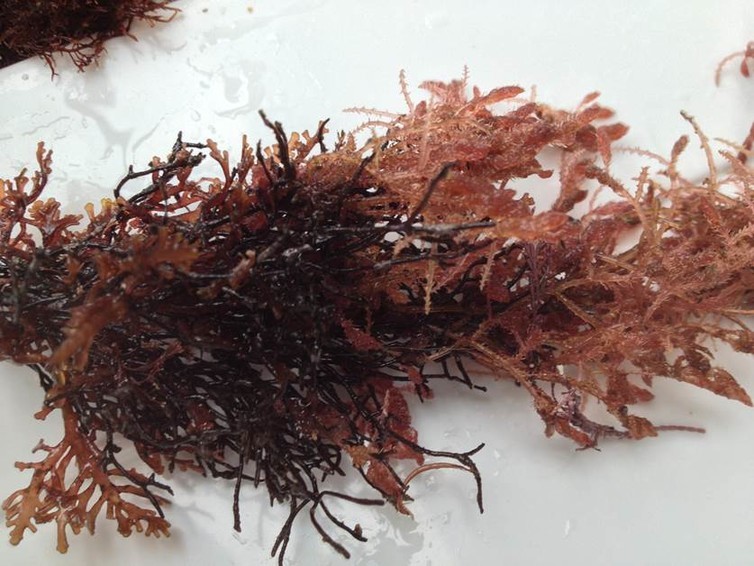
Robert Kinley co-authored two papers of in vitro studies of the effects of different types of seaweed on cow rumen fluids. The first study with his team in Canada showed a reduction of up to 16% methane production doi:10.1007/s10811-014-0487-z. The second study was carried out with another team in Australia which tested a different type of red seaweed called Asparagopsis taxiformis (image 1), which to their amazement showed a 99% reduction in methane production doi:10.1071/AN15576. They also found that unlike other seaweeds it works at low doses of less than 2%. This red macroalgae prevents the methane production through a compound it releases called bromoform (CHBr3) which reacts with vitamin B12. This interferes with the last step of the enteric methane production where enzymes are used by microbes to create the gas.
Now a team led by Ermias Kebreab at UC Davis are the first to test the effect of adding this seaweed to the feed of live dairy cows. Their preliminary results have shown a greater than 40% reduction in the methane they produce. The animal science professor said “This is a very surprising and promising development.” To be able to add seaweed to the feed of the global cattle population would require large amounts of land and water. One company called Australis Aquaculture is attempting to grow Asparagopsis to commercial scale within 2 years. The company CEO Josh Goldman said “If you could feed all the cows this seaweed, it would be the equivalent of taking all the cars off the road.”
Other macroalgae such as seakelp also have other climate change fighting uses. They can act as a carbon sink by sequestering carbon through rapid growth of up to 2 feet per day powered by photosynthesis. This organic store of carbon is then transported away from kelp forests and out to sea through old frond shedding and in storms which rips fronds and whole plants. Some of this material is buried in coastal sediments and the rest floats out to the deep sea. One study suggests that as much as 11% of the total seaweed production is sequestered in the seabed which is more than previously thought doi:10.1038/ngeo2790. Another use for seakelp is for use as a source of non-agricultural land grown biofuels such as biodiesel, ethanol and butanol.
The diversity of uses for seaweeds to fight climate change are so versatile it might be hailed as the superhero climate fighter of the sea. Although the ability to supply the super seaweed Asparagopsis at global scale is yet to be shown possible. But seaweed has given us a reason to be hopeful in our fight against climate change and these discoveries couldn’t have arrived at a more urgent time.
 The Planetarian mode of civilization allows sustainability