1. Abstract
Our current political environments and governance methods are inadequate to deal with today’s global challenges of such a large, complex system. We see biased and ineffective political landscapes undermined by systemic corruption and led by irrational decision making which frustrates the process of governance. To help solve this we propose an online collective intelligence forming a hive mind as a nexus between society and government which forms the central plexus of all organisations that contribute to global governance. It amalgamates many independent bodies into a restructured advisory syndicate effective enough to coordinate the allocation of resources in a sustainable and equitable manner. This confederation of specialists can identify, examine, evaluate and incorporate all relevant information on a global scale. Using expert technocrats to quickly formulate the best strategies to deal with current and emerging challenges makes for the most suitable praxis. We manifest a voice for global citizens by incorporating hive mind representatives into national and international government organisations such as the United Nations. This system can bring accountability to government but also to corporations. THM uses anonymous deliberation in decision making which serves as a prototype for government bodies to later adapt for policy formation. This should have the effect of attracting traditionally less politically inclined individuals to government to restore some balance and breakup the culture of cronyism, nepotism and of serving personal and special interests.
THM process involves cataloguing data and connections between knowledge in vast databases to create the most sophisticated resource for information sharing and solution generation. It is a comprehensive consolidation of the innovative tools we have developed to manipulate information and streamline processes in society. This may use virtual reality desktop software and artificial intelligence research to become such a powerful method for knowledge curation. Its development is based on commons based peer production but will involve a mixture of paid leadership positions and volunteer contributions with possible monetary incentives. This situation may create a compelling case for installing a universal basic income. THM collaborates with governments to disseminate information to citizens using direct communication such as a citizen email address. This forms the basis of a gateway for people to access the hive mind and to establish an official hub of the internet. The aim is to support new generations of competent co-creators of the future by inspiring and molding children during their school years. This includes lifeskills education and guidance to maximise their potential in the fields and roles best suited to their skills and passions. A distinguishing core value championed by THM is the Planetarian lifestyle advocating for sustainable food choices to improve our lives, society and the environment.
THM creates a framework for developed nations to reform all policy areas so citizens, government and corporations can freely choose to make sustainable actions. This can then be extended to support developing nations to implement these processes to improve quality of life and the function of their society. The Planetarian hive mind model proposes a long-term vision to support and evolve our emerging advanced civilization. This endeavour can bring us closer to a knowledge, understanding and technological singularity faster than any other method. This acceleration of human progress is urgently required to fix world problems and to develop tools that could make interstellar travel a reality.
The Planetarian hive mind model is largely a floating agency which modifies current institutions to adapt their governance procedures. There is a bridging between the academic and political spheres by creating high-level security rooms and computer stations within both institutions for its members to access the hive. In these institutions technocrats, hive representatives and ministers can all use THM for information gathering, solution finding and decision making. Computer engineers and cybersecurity experts will take up residence in dedicated secure server sites possibly also located on university campuses.Global users are instructed on how to increase computer privacy and access the hive through proprietary anonymising software. Hive representatives can meet with prominent non-governmental organisations, think tanks, philanthropists and financial and commercial representatives at the Planetarian world summit. Here they can review global progress via online video conference and in person. All discussions must be authorised to ensure they don’t increase the risk of sabotage by groups that may be negatively affected by such discussions. A constitution will outline a code of practice and protocols to maintain a focus on creating content for progress. THM uses a tailored deliberation process and algorithm to determine the most practical, logical and beneficial strategies for long term sustainability. This informs decision making which can be used in the hive online and within legislative bodies over the secure intranet. The output of the hive is governed by a small group named central command who are responsible for authorising discussions and communications between hive, representatives and government.
THM is designed to avoid corruption by being essentially unbribable as contributions are all anonymous. Great lengths will be taken to create a stable and secure online platform where user data is safe and the hive is protected from hacking. Central command and leadership members of the hive are appointed in the spirit of noocracy which is a system of rule by intellect. Therefore, academics demonstrating the best working knowledge of global issues and a commitment to the preservation of the planet are selected initially by THM commissioning team and later through a review process by the hive leadership team. Hive representatives can be elected by online campaign and voting.
THM convenes an allegiant, diverse and illuminated peer group to carefully map and navigate for humanity through this seemingly insurmountable impasse. It will take the height of human cooperation to redesign, refine and regulate our civilization. This is the remediation that can rectify our oversights of the past and obviate potentially irreversible future damage to world systems. Ultimately it has the potential to be the paragon of human leadership and autonomy that provides a final united aegis for the planet and the life present here.
2. Description of the Model
Introduction:
The world currently operates under a de facto world government comprising financial organisations and the corporate ruling class. Under this capitalist system, we see predatory global corporations internalize profit and externalize ‘true cost’ (the actual cost of consuming non-renewable resources while accelerating climate change (CC)). Greed is most responsible for CC; that of the world’s largest private corporations which seek unlimited financial gains. Corruption also worsens the opportunities to prevent or lessen the impact of CC risks, as resources and efforts are squandered. The world economic forum estimates the cost of corruption equal to $2 trillion each year [1]. Corruption of the few imposes poverty on the many and this itself leads to all other afflictions of our society. These are listed as the 10 threats in the 2004 report by the United Nations (UN) high level panel on threats, challenges and change [2]. These include disease, environmental degradation, wars, genocide, human rights atrocities, terrorism and transnational crime. Our governing institutions are in mass disarray and are now less reliable than required to support a competitive, complex democracy. An example in Europe is how democracy is undermined because important decisions are made by an unelected troika of The European Commission, International Monetary Fund and The European Central Bank. This centralised power in our world economic systems ensures that policy is insulated from politics and the general population has no role in decision making (DM). This is called technocratic insulation meaning that a group of technocrats work in insulation from the public to design policies. Our present multilateral order is now outdated being formed in a different environment at the end of World War Two. Modern global governance (GG) clearly requires updated supranational organisation to make enforceable decisions to address global risks.
The crisis we face right now requires the implementation of such tough measures that politicians would fail to get the necessary political support to introduce them. The political spectrum is so fragmented and political conversation so acrimonious that the concerted and determined answers that are needed can’t be provided by political figures. In situations of political and economic crisis, we have seen nations defer to technocrats to help solve the issue such as in response to the great depression, formation of the Soviet Union and in Italy in the 1990’s. Technocrats possess the reputation necessary with both their knowledge and a sense of putting national interests above party political interests. But this strategy was always a short-term fix because the political challenge and backlash of imposing austerity measures mean technocrats lack the political legitimacy that elected party politicians bring to government [3]. We propose here a method to bring a permanent technocratic element to politics which advocates for application of the scientific method to solve global social problems. A technocracy makes the role played by money and economic values less emphasised and more concern is given to sustainability within the resource base instead of corporate profits. It is based on a meritocracy or geniocracy where the ablest become the authority and if possible, largely without the influence of special interest groups.
A technocracy using science based methods is vital as a backbone for progress but it will be useless from a humanitarian perspective if we can’t transcend violence, politics, class, greed, power, states, countries etc. These are relics of a primitive mindset and we must awaken to this awareness if we are to move to a mindset of an advanced civilization. Overcoming these debilitating aspects of ourselves will take new value systems and learning to communicate with rationale and diplomacy. Miscommunication, misunderstanding and misconceptions are derived from these negative cognitive habits such as ego, fear, personal attacks, bias and impulsively responding, which stem from a lack of awareness. To transcend our inherent human limitations and bring technocracy to GG we propose the creation of an online community which extends into the real world using representatives as a proxy within governing bodies. This online network will function as a collective intelligence as the hive mind (THM) with three primary areas of focus. These are in the support of governance (including management of the business sector), the support of individuals in society and to help accelerate progress in academic and technological research and development (as shown in image 1a). In the spirit of the scientific method we would use THM to test two hypotheses:
1.) There is an optimal design of a system, procedure or algorithm that can be used to form a hive mind capable of finding solutions to any reasonable problem posed to it. Any iteration of a hive mind (if working correctly) should be self-correcting i.e. Efficiency and accuracy improving. Thus, it should discover this ‘perfect design’ as a part of its development processes.
2.) There is always one form of GG and organised civilisation which is more optimal than any other arrangement at any time and this could be determined by THM should 1.) be true.
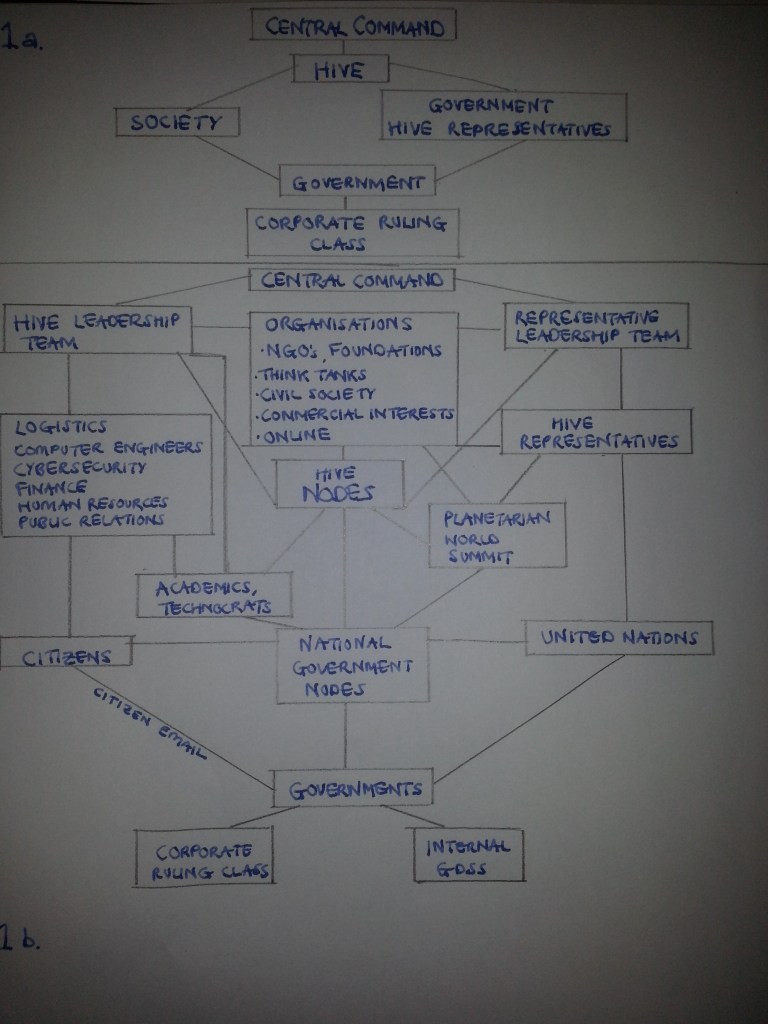
THM will largely be led by technocrats in all fields, mainly by academics, but it aims to be all inclusive of the public in more advanced stages of development. It essentially acts as an information channel between society and government via the representatives which can fortify both these groups to become more effective.
Governance:
The UN is the world’s only truly universal global organisation but it is only weakly connected to the masses. Our proposal aims to change that by creating the world’s second universal global organisation as THM which is largely created for and by the people. But we also would like to join these two organisations to bring more legitimacy, credibility and impartiality to both their endeavours and improve their efficacy and bring much needed change to society. The Hive exists largely online connecting experts globally including world, business and academic leaders and the public. But to link THM to the UN there would first be a process of developing it over some years to such a state of reputability on issues such that it becomes an authority on global affairs. We propose the creation of an organisation which is viewed as cooperative and non-threatening to the existing power structures of the world such that we may make a seat at the table for the masses in such a way that democracy doesn’t currently allow.
Upon achieving a certain autonomy and stability of THM we would attempt to embark on the ambitious task of applying first for non-member state observer status to the UN. Whilst it may seem unusual to induct a largely stateless and faceless entity to the UN there are other atypical examples which indicate flexibility to the process. This includes the Holy See which is the ecclesiastical jurisdiction of the catholic church in Rome and the sovereign entity with statehood over the territory of the Vatican City state. In 2004, after 40 years of observer status, they were granted rights of full membership, except for voting rights. THM would strive to emulate such a process but hopefully with an accelerated timeline. There are many intergovernmental organisations which have observer status to the UN including CERN, Interpol, OPEC, OECD, University for Peace, The Red Cross and the Olympic committee.On this basis, acquiring observer status for an online organisation representing all global states as a voice for citizens is a reasonable prospect. Using the Holy See as a unique example of membership provides leverage to entertain the idea of THM attaining membership simply beyond just being an observer. The Holy See’s membership is not without question since some claim that being a religious organisation it should not have the right to participate in a position analogous to that of states in the intergovernmental DM process on social, cultural and economic matters. Also, the lack of status for other religions is cited as another point of controversy [4]. Achieving status of full membership, or something close to it, would allow THM to be represented by individuals who speak for the technocrats and informed masses on global issues. They would exercise an impartial voice of reason backed up by the rigorous online discussion of topics so they can raise issues and participate in UN debates. By setting such an ambitious goal at the inception of THM we raise the bar for the expected functioning of the organisation to achieve. This will provide a milestone to work towards and will help provide momentum throughout the project.
This might seem a fanciful or unrealistic proposition but it would be wise to assume that the consistent degradation of our environment is likely to continue under the current operating power structure. It might also be prudent to assume this structure is unable to take effective action to prevent this destruction, perhaps because of extreme aspects of human nature which arise when such power is involved. It may be that powerful groups of people are stuck in a deadlock or stalemate in which they refuse to give way to rivals and choose to maintain all resources at any cost. But we should also hope that there are individuals within the power structure who strongly desire for more sustainable practices and would welcome this new and harmonious element to help restore balance to the world. Another likely cause of the inability to correctly manage our civilization is extensive regulatory and deep capture of government agencies. This is where government failure occurs when a regulatory agency prioritises the commercial or political concerns of special interest groups over the interests of the public, leading to a net loss to society. Members of government committees are subject to many factors which prevent them from stopping these abuses of power. Rather than risk their career and take a stand by challenging big business they choose to hold onto temporary power and maintain the status quo. The system is inherently skewed to keep members in the ranks over decades that are prepared to accept this; those who do not will either leave or experience righteousness fatigue and stop fighting for what is best for society and the planet.
THM representatives can do things that named political persons are unable to do such as continually raise and back controversial, but necessary issues and to remain consistently critical of global policy in attempts to steer humanity back to safety. They act as adjudicators to party politics and GG by emphasising the best strategies over those favoured by lobbyists and commercial groups. Their presence in the political system would be a symptom of the serious disorder society has created and are there to remind our leaders each day about the severity of the situation. By 2050 world population will approach or exceed 9.6 billion so we must prepare carefully, not only to dismantle the damaging systems we have created but also to support so many humans sustainably. This can only happen using holistic and improved education, planning and implementation within business and society.
Powerful interests may wish to silence, as they may see it, organised dissent and so topics discussed must be cautiously controlled and monitored. All major discussions would require an authorisation process to engage the hive and controversial topics of discussion will be disallowed to avoid infiltration, sabotage and obfuscation. THM will make it clear that our purpose is to assist governance and that it is best to focus on the issues which require the most urgent attention. This is not a limiting of freedom of speech since there is an entire internet to discuss any subject, but for intents and purposes of the hive, some censorship is justified. The idea here is to create a channel for technocrats and the public to have input on global DM if only in a passive manner to begin with. This allows for an informed network of individuals to engage these topics and to discuss and research how matters on the planet can be handled more appropriately. Once this has been established it can exist not only as a support but as a legitimate entity to defer to as has previously happened where technocrats were brought in to lead governments through crises. It could also even serve as a standalone governing body capable of taking the reins from the current power structure. This may happen if current leaders determine that THM is most fit to govern or if global conditions deteriorate to such an extent that a social revolution demands this. So ultimately, we would be creating earth’s plan B as either an adjunct, successor or as a last resort to our current system.
Integrating the hive mind into governance:
Integrating THM with the UN using representatives is a process that could be replicated with nation-state governments and would improve GG. Again, perhaps initially as just an observer with a view to securing the analogous position of the holy see in the UN as a non-voting delegate. This position allows the right to participate in all meetings open to all member states, the right to make points of order and to exercise the right of reply, the right to circulate proposals and position papers as official documents, and the right to co-sponsor draft resolutions and decisions. Just as in the UN, these representatives act as a neutral voice which can withstand criticism and act to inform of the negative consequences of poor DM. They are also the visible and audible reminder that government is working for the people and to reinforce accountability of decisions made. It should be mentioned here that THM is divided into subsections or nodes which allow online members to subscribe to different nodes to learn about and participate in particular issues and topics. Each national government which integrates hive mind representatives into its organisation will have a dedicated node online, exclusively for citizens of those countries to subscribe to, at least initially. This does raise an interesting point that if we are to become a more balanced planet, would we see the dissolution of national boundaries begin with international online deliberation on individual national policies by all global citizens?
With the introduction of THM into governance, we would hope to influence the very structure of DM within governments and intergovernmental organisations. Much of our problems with existing systems are those stemming from human nature such as ego, fear, greed and self-serving motives with a lack of ethics. When this element is taken into context of human behaviour in groups with power, we see poor outcomes in decisions and actions. Even our best examples of cooperative problem solving such as scientific research are not immune to the inefficiencies our nature causes. There are cascades of collective cognitive pathologies within the intellectual coalitions such as ingroup tribalism, prestige-seeking and moral-one upmanship. It is expected that technocrats and scientists would have better or more accurate views of reality and beliefs because of greater specialised knowledge depth. But individuals will settle on beliefs and views by both consciously and unconsciously reviewing the social payoff in being coordinated or discoordinated with others’ beliefs. Because intellectuals network in self-selected groups linked by discipline, department and institutions, there is an incubation of endless self-serving elite superstitions and this can be said for most other organisations also [5].
Within groups where the main tasks are to make decisions such as in management or governance structures we see a huge range of pitfalls in group discussion. To name a few these include,
Bolstering: where decisions are formulated quickly without thinking it through and then it’s favourable aspects exaggerated to seem more effective than it really is.
Satisficing: which combines the words satisfy and suffice where members accept low risk, easy solutions rather than searching for the best solution.
The law of triviality: where the amount of time a group spends discussing an issue is inversely proportional to the importance of that issue.
Abilene paradox: This stems from groupthink and herd mentality where the group is unable to manage agreement. The course of action decided upon can be counter to that of many or all in the group where members choose not to ‘rock the boat’.
The methodology of THM will use technology to help minimise or completely remove these inefficiencies and demonstrate its utility thus encouraging its use in governance. We are already seeing the use of the internet within governments which is broadly described under the term e-governance which has four primary delivery models:
Government to Citizen (G2C)
Government to Business (G2B)
Government to Government (G2G)
Government to Employees (G2E)
THM would focus efforts on strengthening the G2C component and to develop, inform and support the G2G component. As an example, the UK government uses an IP based virtual private network (VPN) called the government secure intranet to allow file transfer, directory services, email exchange and voice and video services. THM would seek to augment communications over government intranet using specially developed group decision support system (GDSS) software which will include the key element of anonymity for specific discussions and proposals. Traditional DM research has held that if identity is not known groups can make better decisions. We see this for many reasons including that low status individuals who have helpful information but don’t want to express their views in front of high status individuals; individuals making incorrect attributions about another’s expertise and incorrectly deferring to them; high-power individuals commanding too much discussion time. In studies testing anonymity in DM they found it generated more novel arguments and more contributions, particularly critical ones, which is beneficial if constructive [6]. We see anonymous critique as a successful method such as in the example of the double-blind review process for academic journals. It promotes objective evaluation of inputs by the recipient as it helps individuals to cognitively separate contributions from their contributors [7]. Whilst anonymity has its benefits it is likely to be imperfect the smaller the group number such as in parliamentary party committees. A study tested whether anonymous comments were truly anonymous by examining comment length, evaluative tone (especially the use of humour), prior group membership and prior communication among group members on attributions made about the identity of the authors. The attributions made were significantly better than chance but most of them, however, were incorrect so even in small groups a certain level of anonymity is possible [8].
The use of anonymity in GDSS’s would be perfected with its use in THM and so it would provide immediate benefits upon it’s transference to government. This will transform government by retaining and attracting individuals who were previously uncomfortable with the irrational nature of human group decisions. These people may be effective leaders but choose to avoid roles in governance because they perceive our current institutions to be lacking in efficacy and integrity. Factors such as cronyism, nepotism, corporate influence and pathological competition all obstruct progress and make current politics a hostile working environment. So, it only attracts individuals robust enough to tolerate it but this limits the pool of talent available. Thus, THM will help widen the expertise base since it allows for important, but potentially unpopular viewpoints to be heard anonymously within government without fear of reprisal or rejection.
The Role of the Hive Representatives in Governance:
In intergovernmental organisations like the UN there would likely be a single representative from THM for personal communications and during meetings and but would eventually expand to include representation in all major UN agencies. In national governments, representatives would be small in number initially but would eventually grow to equal the number of the most senior government ministers. Using UK parliament as an example, the cabinet is the collective decision-making body comprising the prime minister and 21 cabinet ministers. So, the hive would create a node for UK government and have 21 sub nodes to discuss the various issues pertaining to each government department. A representative is then selected for each of these sub nodes to attend government meetings to deliver findings of the hive, help develop policies and question government decisons. This is something like the shadow cabinet which is formed by the opposition party members but crucially hive representatives are not electable and can, therefore, offer an unbiased viewpoint. The inclusion of THM in governance can bring a trans partisan dimension to party politics which accepts the validity of truths across a range of political perspectives. It will help to synthesise all viewpoints into an inclusive, pragmatic container beyond typical political dualities. Thus, no point of view is excluded and none are exclusive of any others so the hive can act as a balancing mechanism in our largely bipartisan political democracies.
A caveat to the hive’s role in government is that it won’t interact or interfere with secret service intelligence agencies. They are a vital part of national defence and the information they possess and acquire is confidential and classified therefore they will operate as normal and be handled by government officials in the usual way. So, in conclusion, we are not trying to completely overhaul governance but create a hybrid of conventional politics and e-governance using THM.
The Hive Mind:
This section explains the structure of THM and how it fits into governance as shown in figure 1b. The name of this global brain derives from its resemblance to an insect colony where each individual carries out specific duties to contribute to the whole. Such an online network created to address the world’s most pressing problems would be the convergence of countless man-hours spent developing ideas and software since the birth of the internet to become this vast interconnected modular framework. It would become the official place on the internet to contribute to and monitor global progress in solving planetary issues using G2C e-governance to connect citizens to THM. This way, the public can become aware of its existence through official government communications and promote engagement with GG. It should be something like a home or hub of the internet which is why it would champion the importance of having the internet as a global commons and to be an ambassador for net neutrality. Its function will bring unique applications of the internet all together in one place and help bring order to chaos from the masses of information networks online.
To be able to process and view all the multiple sources of information on THM it would be useful to incorporate virtual reality workspaces allowing many windows in the field of view and to explore 3D mind maps. Human knowledge has so many complex interrelations that it is described as having intertwingularity and this requires a 3D model to map it out. This cross connection among a myriad of topics cannot be divided up neatly and so virtual reality is needed to visualise this. THM will draw upon the functionality of many websites currently on the internet and bring them all together either by using similar ideas or partnering with them to use their proprietary software in return for advertisement privileges. These include:
Database and answer engines – Wikipedia and Wolfram Alpha [9]respectively
Question and answer sites – Quora[10], Stack Exchange[11], Physics Forums, Yahoo Questions
Diverse, selective news feeds – Reddit World News, Slashdot[12], NasaTV
Opinion poll sites – Unu[13], Pollmole[14], Survey Monkey[15]
Mindmapping tools – Pearltrees[16], Groupmap[17]
Academic research – ArXiv[18], Academia.edu[19], Zotero[20], Researchgate
Education sites – Khan academy[21], Stanford online, Skillshare[22], Youtube
Research tools and citizen science – Diigo[23] and Zooniverse [24]respectively
Automatic summarization tools – SMMRY[25]
E-petitions – Avaaz[26], Change.org[27], UK and US Gov petitions
Collaborative consumption/peer to peer – Kickstarter, Indiegogo, Gofundme
It would require full time paid employees to work on the hive which could include hive users that demonstrate expertise, proficiency and commitment to the cause. There would be a reward system developed for users making useful contributions possibly using a cryptocurrency like bitcoin as payment. The stack exchange serves as a good model for a system of reputation and rewards to honour useful contributors. Reputation points would enable users to attain positions of leadership in discussion and the rights to raise new ideas for topics for future discussion. This leads us to the gamification of THM with virtual reality, reputation points and financial incentives available. This can attract and inspire the younger generation who have vast learning potential as well as energy and eagerness.
One of the most important aspects of THM will be the use of anonymity during group discussion and other activities, for reasons previously mentioned. To still account for accrued reputation points and monetary rewards there is a need for a two-step authentication process to access the hive network. First, they would sign into a personal account which contains user data such as verified qualifications to assess the expected level of user input and select a classification based on expertise. Then they access the hive network through a second authentication process which assigns a unique anonymous designation for the session duration. Any activity during the session such as upvotes and incentives awarded are documented and are applied to the user’s personal profile and recorded in their account. The hive will reward commitment, consistency, constructive criticism, ingenuity, leadership in group discussion and useful contributions. This system does raise the issue of cybersecurity and hacking, which can compromise the privacy of user identities and lead to the abuse of the financial payment and reward scheme. To minimise or hopefully eliminate this threat a dedicated cybersecurity team is essential in the safeguarding of THM and their knowledge will assist in designing a secure site. So, recruiting and employing ‘white hat’ hackers and educating users about online privacy by recommending software and programmes to use is vital to the success of THM. The use of opensource is again emphasised such as using Pretty Good Privacy (PGP) encryption, live operating systems like Tails and browsers like Tor. Blockchains can be used to secure financial payments, which are an open, distributed ledger that can record transactions between two parties efficiently and in a verifiable and permanent way. It may even require a technology revolution to allow this kind of anonymous global cooperation online with new encryption software and hardware.
As mentioned, an authorisation process will be in place which determines what topics can be discussed and this comes directly from central command if such approval is deemed necessary. There will be a constitution establishing directives, protocols, policies, procedures, regulations and a code of practice to outline the maximisation of productivity and provide guidance on subjects to avoid. This mandate ensures that the hive works on problems most requiring attention and retains neutrality by discouraging excessive naming and shaming. With any problem, it’s always best to first determine the severity of the issue, in this case, it will be documenting global devastation and destruction and then to list current methods being used to solve these problems. Then pinpointing the issues at the core of the problem and to develop strategies and more optimal solutions to co-ordinate future efforts. This will involve the creation and curation of lists and databases and then surveying and ranking data on perceived relevance and value. This knowledge retrieval can make use of website annotation tools such as Diigo [28] and it will employ hive roles including scribes, data entry and database editors in the curation of wiki style files. The machinations of the hive exist in the collection, judgement and interpretation of this data which leads to its analysis to generate solutions. This will use a combination of a chat and forum format for deliberation incorporated into GDSS. It is this mass collaboration of individuals where a roadmap will originate to formulate an optimal form of GG. This relies on the development of a research platform which is not only capable of finding such a form of governance but in solving any other reasonably complex problem. These are the aforementioned hypotheses 1.) and 2.) and testing them may lead to investigations of how an artificial intelligence (AI) would use algorithms to find answers and using THM to model this using human brains as processors. The knowledge and methods used in AI research to programme software that uses logic, reason, deduction and analysis could be the basis for a symbiotic relationship between the development of THM and AI software.
The exact format of THM would need detailed research and planning beyond the scope of this essay. But there is much research being done on this concept by both university and government such as the SWARM project[29], Create program[30], ACE program[31], Collaborative Innovation Networks (COIN)[32], Good judgement project[33] and Scicast[34] to name a few. But it may adopt some of the principles of commons based peer production (CBPP) where individuals self-assign tasks that suit their own skills, expertise and interests. CBPP refers to any coordinated, mainly internet based effort whereby volunteers contribute project components and there exists a process to combine them to produce a unified intellectual work. Ideally, participants can work asynchronously without having to wait for each other’s contributions or coordinate with each other in person. Examples of such projects include Linux, Github[35], Wikipedia, Slashdot, SETI@home[36] and wikiprogress[37] which relatedly, is a project for collecting information and data on measuring the progress of societies.
Citizen membership to THM would aim to be global in the future with every person given the chance to participate in the development of society. At the beginning though it would recruit experts from all fields and form connections to all major institutions including government, non-governmental organisations (NGOs), think tanks, civil society (advocacy, labour, religion), commercial interests, foundations, charities, academia, academic journals and online organisations. Leading members of these groups will be given high status within the hive because of their knowledge and expertise and will be invited to the Planetarian world summit to review global progress. There will be pathways of information flow between these groups and the hive to provide new ideas and insights. Once data is received it is processed to extract the most useful information and then synthesised into a concise format for ease of dissemination within the collective. The hive will rely on academic institutions, whose members including professors, staff and students who not only have ideal research training but often less rigid time schedules which can free up time for THM. Working alongside government on this issue, it may be possible to arrange for university associates to be provided with financial assistance to help with the hive research and operation. This could be the trialling of something like a universal basic income which could eventually be rolled out across nations for individuals to be supported financially to allow committed citizens to devote time and energy to working on THM.
By bringing together the biggest organisations, foundations, philanthropists, global experts and citizens under this one consortium, we jointly form a visible authority. When the hive asks governments and corporations the tough questions; they will not be responding to a faceless website but to the renowned international pioneers of peace and progress with a captive worldwide audience.Correspondences between THM, governments and corporations will discuss the environmental and human impacts that our organizations are causing and will ask of what efforts are being made to halt and reverse this damage. This creates a visible accountability where conglomerates and leaders are obligated to answer for these oversights because these exchanges will be witnessed and documented. The reason THM can have these difficult discussions relies on the inherent anonymity it has; which governments do not possess. Hive representatives can relay information to government assemblies and thereby empower our leadership bodies to fight to do more to repair our damaged ecosystems. A critical primary task for the collective will be to enable governments to install sustainable development, firstly within developed nations such that it can be later be replicated in developing nations. This will involve meeting the 17 goals and 169 targets set out in the sustainable development goals initiative and this will require raising global awareness. The outgoing UN General Assembly president has called for school children to be taught about such things [38] and THM treats educating children about the world as a core value in its mission.
THM motto is ‘Take all variables into account’ and with this in mind, we must ensure that all contingencies are prepared for to prevent this model from being used as a weapon against the people. This will include stipulations in the constitution to prevent this.
An inspiring quote from the visionary Arthur C. Clarke – “New ideas pass through three periods. 1. It can’t be done. 2. It probably can be done, but it’s not worth doing. 3. I knew it was a good idea all along!”
3. Argumentation demonstrating how the model meets the assessment criteria
Core values:
Education:
Today’s society is largely run by a patriarchy and if likened to a family it is as though society is being provided for and parented by a lone father. But father is like a reckless, drug addled gambler that neglects the home and children and caused mother to run away because he was abusive. THM acts like a mother that brings order to the chaos and cares for society to nurture and grow a healthy population. A mother is nurturing and supportive and helps make healthy, effective and aware people; but society is missing this factor. What the world needs now are future generations of resilient and empowered planet savers so the best and the brightest can rise to take on the challenges we face. Our education systems in even the most developed nations are grossly inadequate to teach children about the life skills they need upon leaving school. These include some very basic things that life is made up of like nutrition, conversation, thinking critically and making decisions. Personal relations including social norms, manners, boundaries, empathy, when to speak and when to listen, dating and relationships. Important things like finding a job, handling money, credit cards and personal credit. Life skills like goal setting, time management and learning from failure even self-defence and home repairs. Other subjects such as how governments and the world works including politics, economics and the law. Then miscellaneous topics like mistakes to avoid, self-knowledge, emotions and rationalising difficult situations. When we buy a new piece of equipment it comes with a manual and life should be no different. THM will educate people about how our psychology and crucially how our desires and actions are governed by brain chemicals. This can help people to identify and understand behaviours which negatively impact their life and how to constructively satisfy these brain chemical drives. Many of these things can easily be taught as written courses online or video tutorials. The hive will create standardised, pedagogically optimised education materials and push for government to incorporate them into curriculums throughout schooling years. This can be set within the school day or as homework tasks and is essentially self-taught online. This education can prepare children to recognise the experiences and dangers they may encounter later in life. Incorporating this life education for digital natives in developed nations should be easy but it will be a challenge for the 5 billion poor in developing nations that don’t have time for 18 years of ‘rote’ education. A streamlined education plan is needed for them to help stabilise their nations afflicted by poverty, disease, environmental degradation and all other predations upon humans who are brutalised by their circumstances. Human potential is so often wasted because of lack of knowledge and awareness. Currently, humans are treated as a resource but they are more like capital or an investment. Resources are acquired and utilised in a predictable, linear fashion; but investment capital can be grown nonlinearly, as humans can if you invest in them.
In the UK, G2C e-governance takes the form of the government gateway, which contains information about tax codes and payments. THM would push to expand this to create an individualised government email for citizens to include important notifications or information such as elections, tax changes, changes to laws, local public service changes etc. For instance, during food or technology product recalls potential customers should be informed directly through such a government email system rather than relying on people hearing about such things on the news. This government email would become active when children start school and would connect them to the THM through the online education materials and other areas they may subscribe to for personal or educational development. As they progress in years more of THM functions and learning materials become available to them.
Sustainability:
Sustainability is the fundamental core value of this model because nature demands a dynamical equilibrium for it to continue to support life. In view of this, we have coined the term Planetarian as the name of this hive mind concept, worldview, ideology, movement and lifestyle. It aptly describes a way to operate civilization by putting the planet as the focus of all our activities. Whilst this essay competition does not ask for solutions to world problems we will outline here one fundamental key to sustainability which is powerful but often overlooked. It is the cornerstone of the Planetarian vision and is treated as essential information which should be shared with all citizens because of the huge impact it has. We are talking about the diet of the world’s people. The first law of cybernetics (the study of systems) states that the unit within the system which has the most behavioural responses to it controls the system. If you take the system as being human civilization we can deduce that the ‘unit’ which controls the system is the most valuable to humans. This unit, second to water, is the food which we eat since it is the most basic human need. It also presents a wide variety of choice to each person, particularly in developed nations and these choices have far reaching consequences at many levels. These consequences are the behavioural responses of the system to this unit and can be delineated along three levels.
At the primary level, the choice of food directly effects the consumer’s state of health over their lifetime and thus their wellbeing and happiness. The Planetarian diet promotes eating more meals that are lower in animal products for one primary health reason which is the bacterial toxin load that they contain. Our atmosphere is full of airborne microorganisms including fungus spores and bacteria which is why our bodies need immune systems to fight any invading pathogens. Animal cells are spherical and are easily punctured by bacterium whereas plant cells are square, boxy, rigid and have double thick cell walls for protection. This means that bacteria can multiply in animal products much faster than in plant foods. Meat can be sat on the supermarket shelf for days and add on the time from slaughter to processing to packaging. These bacteria produce waste products just like all life forms do and they create toxins in the animal products. Whilst cooking and pasteurisation can remove living bacteria from animal products it still leaves behind the toxins. People eating two or three meals a day containing these foods are dosing their bodies up with toxins which must exhaust the immune system attempting to clear up this deluge. Interestingly, eggs, when cooked from fresh, are largely bacterial toxin free if eaten soon after cooking because they were protected from bacteria by their shell. Studies have shown that inflammation occurs almost immediately after consuming animal products because of the endotoxins they contain [39]. Perhaps this is the smoking gun that explains the huge increase in poor health of developed nations because of constant immune activation among other factors of our modern lifestyle. The immune system is responsible for clearing up free radical damage which can cause cancers so we need to rest the immune system so it is ready to prevent cancer cells from taking hold. A study found that those eating plant based foods had blood that was eight times more effective at fighting cancer cells than an animal product consumers blood [40]. Then in October 2015 the world health organisation also declared processed meats as carcinogenic [41] so all the evidence is suggesting a radical shift on diet perspective is overdue.
At the secondary level, the food consumed will affect the systems they engage with including family, friends, colleagues and surrounding community. With healthier and happier citizens there will be better functioning families and relationships and less pressure on overstretched national health services.
Then at the tertiary level, it effects the environment since animal agriculture requires large resources and produces large quantities of greenhouse gases. Approximately 20% of all greenhouse gas emissions are associated with livestock production which is more than all transportation combined, including aviation. Global agriculture uses about half of the ice-free land area of the earth and 70% of this is used for livestock production[42]. Agriculture, particularly meat and dairy account for 70% of global freshwater consumption. The UN food and agriculture organisation state that food production would have to increase globally by 70% by 2050 to feed the surging population of the time[43]. There is not a capacity for the atmosphere or oceans to absorb that amount of greenhouse gases or enough land or water to sustain that amount and type of agriculture in 2050. Animal agriculture is also the leading cause of ocean dead zones, world hunger, species extinction and responsible for 91% of deforestation[44]. Meat production is an environmental disaster now. If we try expanding this for a larger global population it will be an unthinkable disaster. Concentrated animal feeding operations (CAFO) use large quantities of water to grow corn as livestock feed and it is the water which is subsidising their operations often without care for water reservoir levels even in times of drought. Large multinational corporations have the power to externalize so many costs and there is no ‘true cost’ accounting. This is short term thinking but we need a long term vision.
There is an overreliance on animal products and this is causing an imbalance in our ecosystem. The difficulty lies in persuading people to change their dietary habits because we experience strong cognitive dissonance when confronted with negative facts about our food choices. Therefore, it requires an open and inclusive paradigm shift which does not seek to eliminate food groups but to advocate for a mindfulness of the animal product consumption of each meal, day or week. The Planetarian lifestyle recommends meals or daily diets be modelled on those shown in the Planetarian wheel of figure 2 and to aim for choices as close to the centre as often as possible. It shows the many ways to moderate the diet which places the role of bacterial toxins at the heart of the issue.
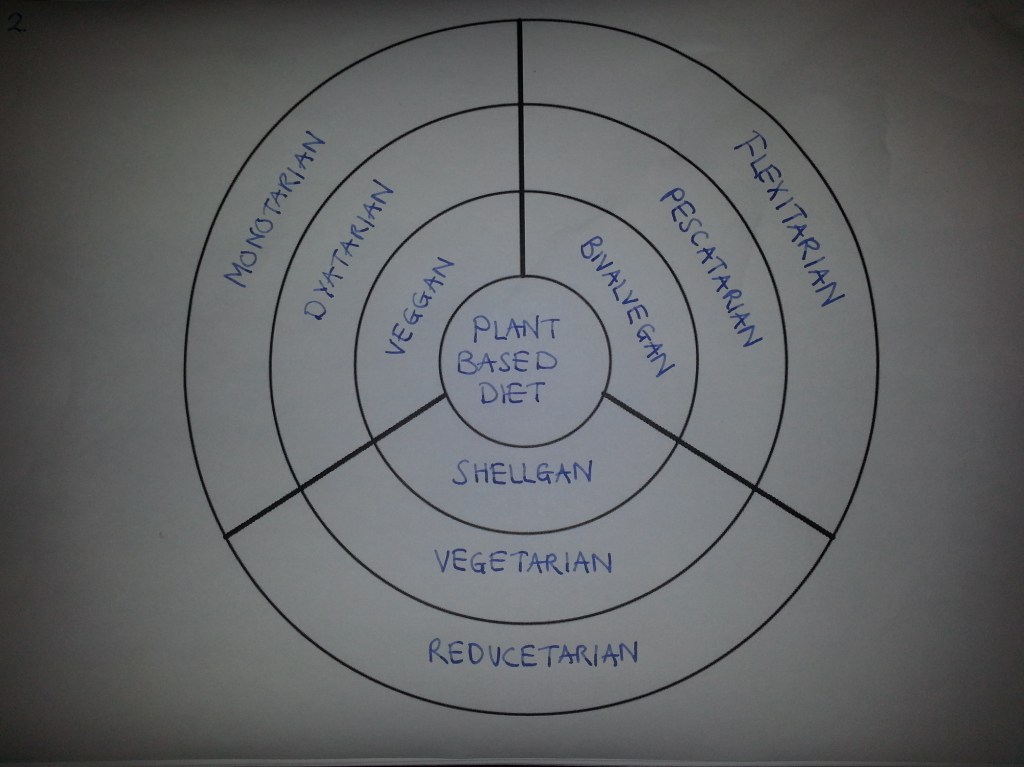
At the centre is the plant based diet (PBD) containing no animal products.
Veggan is a PBD with the addition of eggs, which if eaten cooked fresh from the shell they are bacterial toxin free.
Bivalvegan is a PBD with the addition of bivalves such as muscles and oysters.
Shellgan is a merging of veggan and bivalvegan diets which includes shelled animal products, primarily eggs and bivalves. This is the most nutritionally complete food combination or diet which is essentially bacterial toxin free and sentientist (molluscs are considered non- sentient having no central nervous system).
The unofficially titled ‘dyatarian’ approach to a daily diet where two meals out of an average of three are from the inner ring of the wheel. Thus, two meals are bacterial toxin free.
Pescatarian excludes eating animal flesh except for fish or seafood.
Vegetarian excludes all meat and fish.
The unofficially titled ‘monotarian’ approach which includes eating just one meal of the day which is bacterial toxin free.
Flexitarian is where a person will eat a variety of animal products but moderate the frequency that they do so.
Finally, reducetarian commits to limiting animal product consumption to any degree; examples ranging from ‘meatless Mondays’ to simply cutting out milk from hot beverages one day a week.
So, these simple changes can allow anyone to easily align with a Planetarian lifestyle and move around the wheel as much as they feel comfortable, to do their part for their health and the environment. There is incontrovertible evidence that adopting such a lifestyle as a society is going to be unavoidable if we are to create a sustainable world with such a large population.
Our world is formed by the actions we make individually and collectively. These actions stem from the core values and these in turn effect and determine the social policies of global governance. The Planetarian vision splits these actions, core values and social policies into 5 layers of a pyramid. Upper layers rely on lower layers being optimised.
The lowest layer is that of personal actions which are the basis of consumerism which should be guided by the core values of sustainability including aligning with Planetarian food choices. These effect policies of agriculture, healthcare, family (population), energy and water.
Public action is that of government spending and is guided by core values of communication and information sharing. These impact the social policy of education and society including the functioning of the global workforce. THM calls for budgets to be fully accessible and rationalised in favour of the citizens that bear the burden of taxation.
Private action is largely that of corporate capitalism which should rely on core values of accountability and transparency which determines the social policy of economics and justice. In this context justice refers to corruption since corruption of the few imposes poverty on the many. THM can form a digital network of citizen watchdogs and anonymous whistle-blower havens which increase detection of fraud, waste and abuse. Crime is also reduced by optimising personal and public actions.
Foreign action must be guided by the core value of equality which is needed to overcome the element of kinmanship which manifests as nation vs nation and race vs race. Equality helps to form balanced, progressive and globalised diplomacy and immigration policies.
The apex of the pyramid is governed by political action which is that of our democracies and requires core values of compassion and understanding. These actions determine the security policy of military and defence which, if all the other core values are unified and the corresponding policies corrected then peace is more likely to exist.
Global future actions are determined by the long-term vision we take in all our current actions and THM can inform and improve on these actions using the core values to achieve this.
Challenge criteria:
THM will be able to deliver the necessary networking, ideas and solutions to help resolve global governance policies in the lower two tiers of the Planetarian policy pyramid largely by just informing the public. The implementation of this initiative requires no outside help from government and can begin immediately online. In the first phases of integrating THM into governance bodies, the influence of representatives will largely be only to inform from a perspective based on the core values. But they will also act as negotiators for the future of humanity and in time the hive may become appointed as a voting delegate allowing participation in decision making. Thus, this essay doesn’t offer a complete picture of a finalised governance model but provides an overview of the elements required and realistic steps towards creating such a system. The effectiveness of this model derives from the adaptability of its largely online organization structure allowing for manoeuvrability of human intelligence resources by deploying people to areas of concern when needed. Also, the feature of anonymity introduced into some areas of government decision making provides freedom for politicians to be more impartial in decision making. This creates flexibility in the system and THM itself will constantly monitor where and when improvements can be made. The financing of such a project would require multiple monetary streams such as public and private donation, government funding and philanthropist support. Advertising revenue can be considered also but since sustainability is a core value for THM it would only be for approved sustainable products and services.
THM creates a level of transparency using an effectively networked group of people to analyse global activities and determine their causes and possible solutions. This raises the insight of the collective by allowing many more viewpoints to be considered with the added benefit of identity protection for users expressing their thoughts. Protection from abuses of power within THM will require secure anonymising software for users and higher levels of encryption and secure access methods for leadership members. The core value of equality used to overcome factors such as kinmanship is strengthened by the inherent anonymity of contributions to online discussion since any differentiating feature among users is invisible. Corruption of THM is limited because it uses representatives to deliver the narrative from unknown technocrats so bribery would be ineffective. THM will model an organisational structure using accountable leadership which may serve as an example for real world governing structures to emulate and garner the trust of citizens through transparency.
This essay was inspired by some ideas from the ‘Earth Intelligence Network’ [45]
References
2. https://www.globalpolicy.org/component/content/article/226/32368.html
3. http://www.bbc.co.uk/news/magazine-15720438
4. http://www.nytimes.com/1999/04/04/world/at-the-un-activists-vie-with-vatican-over-abortion.html
5. https://www.edge.org/response-detail/23867
6. http://pubsonline.informs.org/doi/abs/10.1287/mnsc.36.6.689?journalCode=mnsc
7. https://link.springer.com/article/10.1007/BF00126264
9. http://www.wolframalpha.com
11. https://stackexchange.com/
13. https://unu.ai/
15. https://www.surveymonkey.com/user/sign-in/?
16. https://www.pearltrees.com/
21. https://www.khanacademy.org/
22. https://www.skillshare.com/
24. https://www.zooniverse.org/
26. https://secure.avaaz.org/page/en/
28. https://petitions.whitehouse.gov/
29. https://www.swarmproject.info/about
30. https://www.iarpa.gov/index.php/research-programs/create
31. https://www.iarpa.gov/index.php/research-programs/ace
32. http://ickn.org/
36. http://setiathome.ssl.berkeley.edu/
38. http://news.xinhuanet.com/english/2017-09/09/c_136596500.htm
39. http://www.ncbi.nlm.nih.gov/pubmed/20849668
40. http://www.ncbi.nlm.nih.gov/pubmed/16965238
41. http://www.iarc.fr/en/media-centre/pr/2015/pdfs/pr240_E.pdf
42. http://www.europarl.europa.eu/climatechange/doc/FAO%20report%20executive%20summary.pdf
43. http://www.fao.org/news/story/en/item/35571/icode/
44. http://documents.worldbank.org/curated/en/758171468768828889/pdf/277150PAPER0wbwp0no1022.pdf
45. http://www.earth-intelligence.com/wp-content/uploads/2012/10/EIN_flyer_019.pdf
Attachments
 The Planetarian mode of civilization allows sustainability