[Disclaimer: Again this is a very roughly written set of notes, here I am going to say some things which most people would be uncomfortable saying because even scientists fear reprisal, rejection and unpopularity by the masses. I want this species to succeed and survive and to do that I believe that you must act boldly and swiftly. Just in the same way that with a virus infection, the earlier you administer the medication the more effective the treatment is because viral replication is exponential and climate change is appearing to develop exponentially also. So you have to hit it hard and quick to have the best chances of regaining control. You are making decisions here that have the most critical of consequences which are those of the safety and wellbeing of yourselves and your families. I have faith that you will respond with enough vigour because the last year or so has shown a great human passion which im sure can be channelled into this emergency. Your health is the most important thing in life, take it from me, someone who learnt this lesson too late, everything else comes secondary to your health]
A major problem with our societies is that we tend to exist in a singular mode all year round with minor adjustments to account for the changing of the seasons. We could instead reform our structures, practices and habits into a multi moded system that can switch between different modes of using energy or working or eating according to the natural cycles of weather and climate. This becomes again a closer enmeshing of our lives with the natural world, to work with it and not be so rigid in our insistence upon continuing with the same behaviours despite changing conditions.
These proposals would be in addition to the ‘wicked 25’ I proposed in the circular civilization set of rough notes. Some of the ideas are repeated here but I may expand on some and introduce new ideas also. It should be noted that any of these proposals would likely be revealed to the public far ahead of their potential implementation so everyone has time to prepare and adapt to any changes. Hashing out the details of such large scale changes let alone the building of such infrastructure would likely take several years, even on the fastest of timescales.
The fastest way to move towards safety is to reduce global energy usage, particularly that of developed western nations. This a 30-40 year strategy until we can generate power by nuclear fusion which could power much of our energy desires cleanly.
- Move people seasonally – build fleets of electric coaches and build electric charging stations across transcontinental highways. Minimalist nomads paid for their service in reducing the burden on electric and energy grids during winter and water supplies during summer.
- Supply fossil fuel generated power intermittently – For example during summer, coal power stations could supply electricity to homes between the hours of 6am -10am and then again between 4pm to 8pm (16 hours saved without supply). Then in winter time extend hours to say 6am-11am and then 2pm to 9pm (12 hours saved without supply). Times would depend on climate conditions of the region.
So in the morning you may want to use the electricity to make hot water to shower with and maybe handwash or machine wash the previous day’s clothes. To cook a breakfast/lunch and to charge up any electric battery powered goods such as laptops and phones.
The gaps in supply could be filled if the housing is supplied by renewable energy created electricity either from a power station or onsite domestically with solar and photovoltaic panels or wind generated.
If the house has neither power station or domestic connection to renewably sourced electricity, this would create a huge incentive for those with cash and assets to personally invest in such technology. There could perhaps be a case for people being able to trade in petrochemical motor vehicles in exchange for solar panels or domestic wind turbines. These vehicles taken off the road could be recycled or the most suitable and desirable, retrofitted to become electric powered cars.
3. The desire for a constant supply of electricity is perhaps most acutely apparent in people’s reliance on frozen and refrigerated foods. Without a constant supply people could not guarantee the freshness and edibility of foods. It is not likely that the world could afford the greenhouse gas emissions associated with providing renewable energy sources for all housing across the world let alone single western continents such as north America or Europe. The greenhouse gas budget available to avoid the worst consequences of climate change (CC) is probably not large enough to accommodate that demand.
But it is entirely possible to adapt our lifestyle to do without home fridges and freezers without having to revert to Victorian era food storage and consumption habits. There is a case for reducing the production of new refrigerant based goods as the leakage of current refrigerants is a potent CC agent as a greenhouse gas (GHG). Refrigerant management is touted as the number one method to combat CC.
4. If instead we moved to a more centralised production and distribution of foods and meals in the way of local food kitchens and food halls where they could store large amounts of refrigerated and frozen foods. These food halls would require a constant energy supply from renewable, fossil fuel or nuclear power sources. You could still purchase meat and dairy goods but you would be likely to be eating them on the same day of purchase. The movement of people from their homes to food halls, especially during periods when there is no fossil fuel generated electricity provided at home, would change seasonally. Perhaps during summer times more people would want to leave home and travel to food halls whereas in winter time some may choose to stay at home. Conversely people might not feel the need during summer time to visit the food hall as it is warm at home and they have the food they need or during winter people will visit the food hall for warmth also. Depending on weather conditions and regional preferences these systems can be ramped up and down throughout the year.
The foods cooked and provided here could be more plant based as plant food cooking experts could use their food experience to prepare tasty and healthy meals with lower amounts of animal products. This is good for the environment and good for peoples health and therefore puts less strain on healthcare providers. These meals could also be delivered locally using electric powered vans or even more ecofriendly is the bicycle delivery such as that by companies like Deliveroo. Bicycles would become a big industry in the future as they are good for physical and mental health and require no fuels to power. Taxis should ideally be electric powered or at least hybrid and these are a useful public car share. People should adapt to living without a car and traveling less or using bikes or public transport. Have food delivered from supermarkets and visit food halls often to reduce the amount of food needed to be stored at home. The centralised cooking of large batches of foods will be more energy efficient and will also allow better food stock management which will reduce food wastage. Supermarkets and food kitchens would work closely to ensure as little food is wasted as possible.
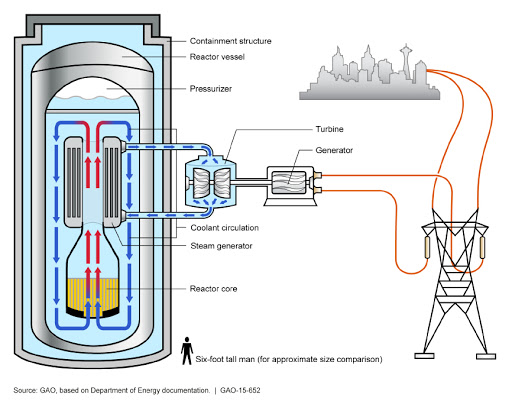
- 5. Coming back to the energy supplied to homes and cities. There is a case here, in this current emergency situation, that small modular nuclear reactors could be very useful to power our essential energy needs and emitting the least amount of GHGs. Small modular nuclear reactors are much smaller than nuclear power stations and therefore are much faster to install and offer a potentially better safety profile (search youtube for small modular nuclear reactors for the facts). These could be used singularly or in multiples to power essential services that require constant energy supply such as hospitals, food halls and food kitchens, supermarkets, water supply companies etc. Perhaps, I would map out which regions and cities are least likely to be affected by CC such as from sea level rise, drought, flooding and hurricanes (assume the worst that all ice covering the land will melt causing 75 metres of sea level rise). Then deploy the reactors in regions strategically to help cover the baseline energy needs of a city or town. Whilst nuclear energy is a last resort and much maligned option, I believe humanity needs all the help it can get right now.
- 6. Working from home and reducing average lifetime working hours from 40 hours per week to 20 per week. Essential workers should hope to live nearby to workplaces to reduce personal commutes and essential sectors could supply electric powered minibuses to pickup and drop off workers at their homes.
- 7. Minimalism. Transform people’s concept of materialism to one which does not need to transport heavy home goods from place to place each time a person moves home. The cost to move large goods may become exorbitantly expensive or people may be encouraged to leave furniture behind for future tenants to use as moving vans require more fuel to move goods and the new production of furniture goods would be greatly decreased in the future as we move toward necessary industrial production only.
- The existing global economy is a convoluted system of multiple currencies, massive national debts, a pricing and value system that doesn’t reflect the true-cost to the environment and the materialistic, capitalist ideals sold to us via credit and debt usury. A very tricky element of the economy to untangle will be the ownership of land and property and the inheritance of such wealth to others. But we will leave that for now with the hope of finding answers in texts such as Thomas Piketty’s Capital and Ideology. But we should aim to not only transform the economic system to one which is beneficial for the planet but do so in such a way that it creates leverage and incentive for those with wealth to invest in the new green economic system to hurry it’s development along. A very simple way to do this would be to collectively decide as a planet to introduce a new currency such as the ecounit which will be used to pay the true environmental cost for goods and to implement a fixed deflation rate on all existing currencies which are inexchangeable for the new ecounit. The only way to receive the new currency is to earn wages for an essential industry or service sector or to invest your existing wealth in the old currencies into all of the international strategies proposed to preserve the environment. This would mean that those with large sums of wealth could still maintain this wealth if they divest from their existing investments and put their cash into projects which support the green development of social and energy infrastructures. They would then receive a profit from these investments in the form of the ecounits and as a result would still be relatively wealthy compared to the working class in society which I think is an important desirable requirement for those with wealth in any future plans. Because there would be a fixed deflation rate on their existing cash to be introduced on a predetermined date this would give time for those with wealth to sign onto many of the new ecounit approved schemes that would develop our societies into sustainable communities that are prepared to undertake radical transformation to mitigate and adapt to climate change. Once the deflation rate is initiated this would apply more pressure on those with wealth to preserve such wealth before their cash becomes worthless over a time frame of say 3-5 years. This mass collection of wealth from the richest would form the necessary funds to bankroll all the projects required to save the planet and humankind. The very action of increasing the development of green energies and behaviours which lower energy usage should be rewarded nationally as write off’s to national debts. The huge national debts are perhaps direct reflections of the material consumption and greenhouse gas emissions of a nation and so previous, existing and future efforts towards sustainable practices should be factored into writing down those debts. Many developed nations have the largest share of national debts and it is these nations which have the sufficient wealth and infrastructure to create sustainable change which would also mean they could lower their national debts faster if their actions towards global environmental protection are rewarded in this manner.
- Understanding the transition from existing currencies to the new ecounit is perhaps beyond my expertise but i envision a blended period of dual currency usage where wages for essential and green services would be switched to ecounit payments and at a later date payment for goods and services at small retailers using old currencies would have been phased out. The profits of existing companies would continue to be paid in the old currency unless they had been certified as green companies and ecounit approved. This would mean that companies using unsustainable practices would have to alter their product to conform to sustainable standards or face diminishing profits once the deflation rate kicks in as the money earned would be worth less and less every day. Perhaps the deflation rate would be calculated on the currency every day but only applied once a month or every 6 months, allowing investors time to carefully divest their existing wealth and reduce panic.
- The idea of a cashless society has it’s dangers but the creation of coin and notes as currency in enough bulk to supply an entire planet’s worth of humans comes with a very high energy and materials expense. Perhaps we would have a personal cash card and a secondary impersonal saving card like a top up card as a safety measure to protect from fraud, damage, loss and card blocks. Again, this is another huge topic to discuss beyond my existing knowledge and research. But they are valid questions to ask as we must be very economical in our endeavour to transition now because literally everything is at stake.
- The ideas of transnationality and bioregionalism require a deeper investigation and i hope to in the coming months find solutions regarding what i believe to be a critical component of a global rescue strategy for humanity. But the best part of many of these proposed solutions is the dynamism they introduce to the system and new degrees of freedom for variability and change. This is room for manoeuvre, whereas our existing system is rigid, linear and we have become stuck. But also with each intervention you should hope to not only solve problems but create incentives which motivate further actions towards resolution, the two birds one stone strategy.
- One thing i have left undiscussed is the idea of overpopulation and birth rate stabilisation. This should be left till last as you first need to understand how peoples will be organised and what their lives will be like before being able to understand how to intervene in managing birth rates. Lowering energy usage across the board is a priority since this would mean any children born into this arrangement of civilization would have less environmental impact than previous generations. But it does also form a necessary requirement to manage competition between nations and as a long term overall energy and materials burden on the planet. The main standouts of this piece were to introduce the controversial elements of intermittent fossil fuel supply and small modular nuclear reactors as drastic measures to fix the planet if the emergency was deemed serious enough or climate events take a sudden turn for the worse to alarm us to act quickly.
 The Planetarian mode of civilization allows sustainability