[Foreword: i wrote this piece off the top of my head, no references, no fancy statistics but instead a more intuitive style. It was only near the end of the draft that I went back into some of my old blogposts and realised I have mentioned this topic several times with other contexts surrounding it. But I feel there needs to be this reiteration at this current time due to rising and urgent pressures from climate change. Please excuse the disjointedness and rambling, im just doing the best I can right now]
Introduction:
There is a ‘climate bomb’ forming on the horizon where climate systems begin to cross tipping points and cause a cascade of mutliple tipping points to occur. It is described as a bomb because these interconnected systems can potentially be changed over a short time frame and collectively cause a huge shift in carbon dioxide equivalents in the atmosphere and therefore effecting climates severely all at once. Thus, we need to use all the mitigation tools available to us to slow or preferably to halt the advance of climate change.
But as we do this, we must also build resilience and especially adaptation to the coming climate bomb crisis. The main focus here is on the food sector of the food, energy, water (FEW) nexus. Here, I reinvoke an idea I was interested in back in 2017, but now for different reasons. This is the idea of the introduction of food halls, food canteens and food kitchens, which will be referred to as food hubs for the rest of this document.
Food systems:
So to lay out the context of our current system; most places in the developed world rely on a ‘just in time’ business model of selling foods in supermarkets and shops. This means that before stocks of food items become low or out of stock, deliveries arrive to restock these items. The problems with this system are potential for unequal allocation, hoarding, shop lifting and looting that may arise in times of food shocks, insecurity or scarcity. We currently enjoy a state of abundance of food in developed nations as we have robust and plentiful farming practices and huge importing power. But with climate change we are seeing lower crop yields and even crop failures due to inclement weather conditions. For example, a lack of rain or water sources, such as aquifers (which are a finite source), that is being plundered at ever growing rates through the digging of deeper wells to access it. At the other end of the spectrum is flash floods or over saturated soils which can effect the planting season times and damage or rot crops from flooding. Also, the over tilling of soils is seeing a loss of carbon rich soils due to water run off during heavy rainfall periods. So these problems in farming, with highly variable and unpredictable weather conditions due to global warming, threaten food security as crop yields are lowered or destroyed completely.
We are now seeing an accelerated rate of global heating and a greater number of extreme weather events. This means we need to begin building resilience into our food systems and be ready to adapt to climate and food uncertainty. This needs to happen from farm to fork, so all areas of the food system are adapted. Here, I only focus on how food is distributed at the point of sale. As I mentioned, conventional food markets are not able to preserve food security for everyone during food shocks. One simple, tried, and tested method to control food distribution is the introduction of rationing; which may be effective in times of scarcity, but it is limited in adaptation capability to solve other issues that climate change presents. These include the stockpiling of food essentials such as grains and cereals. Supermarkets are not designed to adequately prevent mass shoplifting or looting. These shopping venues are also vulnerable to weather extremes such as flooding or wildfires. This ‘just in time’ business model is unresponsive to restocking essentials in times of scarcity.
Food hubs:
The alternative model proposed here is the building of many large and small food hubs. Their purpose would be primarily as a venue for people to come and purchase healthy meals. The cost of these meals would be sold ‘at cost’, since it would be a government run program which does not seek to make a profit. This cost would also be at ‘true cost’ which takes into account other cost factors such as the amount of water used to grow the foods as well as the chemicals such as fertiliser and pesticides to create plentiful crops. These costs are usually absorbed through government subsidies but food hubs would present true costing as a feature of their carbon and environmental footprint.
These hubs would get priority for essential food items to stockpile such as corn, rice, wheat flour, potatoes and oats, and others such as dairy and eggs. The food hub system might also be appropriate to distribute food stuffs to be used for home cooking. The meals offered would be based around the ‘planetarian’ diet, which is high in plant based food and lower in animal products. Eggs are an excellent nutritious food, that when added to a plant based diet, is referred to as a veggan meal or diet. The food offered at the hubs would be from menus devised by experts in plant based cookery to ensure the tastiest and nutritious of plant based and vegetarian meals are offered.
The food hubs themselves can serve multiple purposes. 1. The fair and equal distribution of food to the public. 2. The emphasis of healthy plant based meals (but not entirely restrictive; meat and dairy food stuffs should also be provided but in limited quantities). 3. The stockpiled foods would be protected from theft since they would be locked away in large rooms or refrigerators and with security officers present to maintain order and protect the food stocks. So, in times of extreme food scarcity due to single or multi year droughts or crop destruction, the food hubs can maintain food availability and keep society functioning.
Other features of the food halls could include multi storied waiting areas where people can enter the hubs in an organised and orderly fashion. These waiting areas can also be used as warm spaces in colder months, so people can stay there for a given time frame when it is likely, more expensive to warm themselves at home. At the opposite extreme, the hubs and waiting areas could act as a cooling centre during extreme heat which is particularly useful to the young, old and unwell. It would be useful for people who have no home air conditioning perhaps because it is unaffordable to them. These warm and cool spaces could be created by using heatpumps, since electrification of everything is a useful climate change mitigation tool to steer us away from fossil fuels. Carparks at these hub facilities could be multi-storied to cater to large numbers of consumers. Solar panels and batteries should be used to cover roofs of the halls, waiting blocks and carparks. The amount of refrigeration needed will be a huge energy demand. One option is to use CO2 refrigeration, which avoids the use of atmospherically toxic refrigerants which can leak out of conventional refrigeration and air conditioning units. Services can also be put into place where people who are unable to physically attend the food hubs, can have home meals delivered using electric vehicles. On a related note, in towns and cities, all taxis and buses should be use electric vehicles since they run all day, everyday.
To adapt the food hubs to increasing variability and strength of weather conditions, they should be located on higher ground and perhaps stilted off the ground to avoid floods destroying the buildings. Location is also a tricky part, as land for such facilities is in scarcity due to other businesses occupying it. But if we look forwards to a future where climate change and other economic forces cause businesses to close due to society’s reduced disposable income due to lack of employment (see AI) or rising costs of food, energy and water (FEW). This state would be described as late stage capitalism where consumerism is no longer a dominant force in economic growth but where it causes a retraction of the economy instead. These business closures may be useful for food hubs but it might take too long to wait for such business closures, when these spaces for food hubs are required more imminently than previously realised. As a UK resident, we have large retail parks, like many European and North Americans do. I see these as locations of interest for food hubs since they have large buildings with large floor space and extensive parking spaces. Other spaces which could be adapted into food hubs include religious venues and sports and concert stadium venues which have massive capacity and large parking sites. I would advocate that the government intervenes sooner rather than later to acquire these spaces under the premise that late stage capitalism is going to render these businesses as bankrupt anyway. We need these spaces to adapt to climate change by building resilience into the food distribution system. These kinds of food hubs could serve very large numbers of people in cities. In less densely populated areas such as rural locations, smaller food hubs can be created.
Another factor that needs addressing, is enticing people to use the food hubs, especially if they are built earlier in this changing climate and no emergency stockpiles are yet required for food security. It is conceivable that like businesses becoming obsolete, aeroplane flights might become unaffordable due to reduced disposable income and increasing FEW prices. But perhaps we could tie in the accessing of meals at food hubs with a points system whereby ordering and eating a plant based or vegetarian meal will add points to your membership card. These points can be accrued such that they would count as air miles which would be a new carbon tax placed on flights. There could be an online airmiles market introduced where people can buy and sell airmiles, so if a customer doesn’t want to fly then they can exchange their accrued points for cash. This system would be particularly useful in taxing one of the most wasteful carbon emitters; the users of private jets. A flight on a private jet would require many more air miles points due to the limited number of passengers and thus taxing the unsustainable use of resources and fossil fuels.
Food shocks – war and el nino:
There are other factors which can produce food shocks, such as the current US, Israel- Iran war where a large quantity of the worlds fertiliser and diesel usually passes through the currently blockaded strait of hormuz. This raises prices for farmers who may decide it is not economically viable to grow a crop in a season when stocks are low (fertiliser) and prices high (diesel). As mentioned, weather can effect crop yields and we are currently heading into an uncertain time for the climate as a potentially large super el nino is forming in the pacific at this very moment. The el nino will increase in strength through and into late 2026 and then the following year is usually where the bigger impacts are felt (eg. higher sea and air temperatures). It has been suggested that this el nino could temporarily push global temperatures 1.7 to 1.8 degrees C above pre industrial levels in 2027. This is uncharted territory and could be the trigger to cause positive feedback loops to begin from surpassing tipping points. El ninos can also impact crops badly, particularly wheat, corn and potatoes. All of these variables contribute to uncertainty of crop yields and we must build alternatives to the ‘just in time’ delivery model of supermarkets and shops to adapt to this uncertainty.
Food shocks – positive feedback loops of tipping points:
The speed at which these food hub adaptations are required was not expected so soon since it was thought this kind of food system fragility due to climate change would not occur for some decades to come. But with the noted acceleration of climate heating, it should be recognised that we need to prepare as soon as possible. This coming ‘climate bomb’ could be triggered by any of a number of climate tipping points. These include:
| Thawing permafrost: Permafrost regions of the Arctic, when thawed due to increased temperatures, release the potent greenhouse gas (GHG) methane from existing stores and rotting biomass. An abrupt permafrost carbon feedback from the thaw beneath thermokarst lakes are projected to double radiative forcing from the predicted gradual thaw rate within this century (Anthony et al,2018). This warming will cause further permafrost melt and release of methane. |
| Methane hydrates: Methane, when frozen in water, forms a hydrate ice water. Frozen into the seabed is a reservoir of such methane hydrates (Archer,2007). If this were to melt it would release the methane and cause further warming thereby forming a feedback mechanism causing ice to melt at further depth in the seabed. |
| Polar ice melt: Melting sea and land ice at the poles reveals the seawater or land beneath it which decreases the albedo for incident radiation and more is absorbed by the planet than would be reflected by ice. This further warms the land, atmosphere and oceans causing further melting (Andry, Bintanja & Hazeleger,2017). |
| Increased water vapour in the air: Global warming can cause more sea and land water evaporation which creates more clouds. This traps more heat in the atmosphere and exacerbates the greenhouse effect (Trenberth et al,2015). |
| Migration of tropical clouds: Movement of clouds away from tropical regions toward the poles can lead to decreased rainfall and expansion of sub-tropical zones (Norris et al,2016). New research suggests that clouds could disappear completely at an atmospheric carbon dioxide (CO2) concentration of 1200 ppm. The planet could be on track to reach this by 2100 in a ‘business as usual’ scenario. This would happen in a world which is 4°C warmer than pre-industrial levels (PIL) and would further warm the world another 8 ° C. Such an event would wipe out most life on earth including humans (Schneider, Kaul & Pressel,2019). |
| Green carbon sinks – forests, terrestrial plants and soils |
| Forests and plants: With increased deforestation and forest dieback we see less CO2 absorbed by photosynthetic plants and trees. This allows atmospheric CO2 to rise which increases temperatures further and causes more forest dieback. Forest dieback contributes to precipitation reduction, firstly, by the biophysical feedback of reduced forest cover reducing evaporative water recycling. Secondly through the biogeochemical feedback by the release of CO2 adding to global warming. There is also a physiological forcing whereby rising CO2 forces stomatal closure which is the site of the plant through which gaseous exchange occurs (Betts et al,2004). Forests and terrestrial plants absorb carbon through a phytolithic sequestration process which is coupled to the biogeochemical silicon cycle. Silicon fertilizers can enhance carbon uptake (Song et al,2017). |
| Soils: Soils contain more carbon stores than all terrestrial vegetation and the atmosphere combined (Batjes,2016). Intensive agriculture from overgrazing and tilling contributes to depleting this vital carbon sink which could be managed better with regenerative agriculture methods (Marshall,2015). |
| Blue carbon sinks – Oceans and coastal ecosystems |
| Oceans: The solubility pump describes the process of atmospheric CO2 dissolving in seawater and it is the primary mechanism of CO2 uptake in ocean waters (Lade et al,2018). The solubility of CO2 in seawater decreases with increasing water temperature and thus with less CO2 absorbed there is increased heating which further reduces seawater CO2 solubility. The biological pump is that which describes the ocean life which sequesters carbon through the food web. An essential part played in this food web is that of phytoplankton which absorbs carbon into their shells. Ocean acidification, which increases with the increased amount of CO2 absorbed, reduces the ability of phytoplankton to thrive and form the carbonates needed for their shells thus reducing their numbers and sequestration capacity. |
| Coastal ecosystems: Mangrove forests along the coasts are also a carbon sink which if lost to sea level rise would reduce CO2 absorption and create a feedback loop (Wilson,2017). |
| Teal Carbon sinks – Freshwater wetlands |
| Wetlands: Wetlands hold a disproportionately large amount of carbon when compared to other soils. They only account for 5-8% of the earth’s land surface yet hold between 20-30% of total soil carbon (Nahlik & Fennessy,2016). |
Here is another list which describes some of the same as well as other tipping points:
| Green house gas concentrations in the atmosphere |
| Forest Dieback weakens the ecosystem leaving it more vulnerable to further dieback |
| Forest Fires spreading to human settlements increasing carbon dioxide emissions |
| Polar ice caps, sea ice and glacier melt reduces surface albedo and increases sea level |
| Melting of permafrost and methane hydrates under sea releasing potent GHG methane into the atmosphere |
| Watervapour in the atmosphere as a green house gas |
| Migration of tropical clouds towards poles, Unpredictable changes to monsoon seasons |
| Jet streams – Polar Cell, Ferrel Cell, Hadley Cell |
| El nino and La nina oceanic phenomena |
| Thermohaline circulation disruption due to decreased water salinity |
| Aquifer and water table depletion |
| Increased carbon dioxide can cause stomatal closure in leaves which limits gaseous exchange and decreases the uptake of further carbon dioxide |
| Rainforest hydrological cycle, transpiration from trees creates microclimate that is self sustaining and recycles water in that ecosystem |
| Boreal Forests as carbon sinks |
| Mangrove forests as carbon sinks |
| Wetlands and Peat bogs as carbon sinks |
| Soil erosion as soil is a vital carbon sink eg. Overgrazing, tilling |
| Rainforest Land Coverage as a carbon sink |
| Ocean biological pump – eg. Phytoplankton as a carbon sink and oxygen producer |
| Ocean solubility pump – beyond carbon dioxide saturation it can no longer absorb it |
| Ocean acidification – reduced capacity of marine life to build their carbonate shells in more acidic oceans |
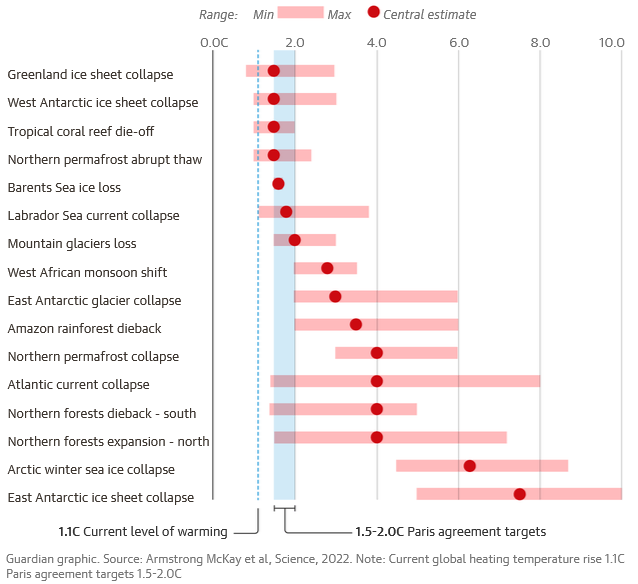
When this climate bomb triggers due to any of these tipping points being transgressed, we need to be prepared and adapted so we can be resilient against climate threats. I don’t feel that the term climate bomb is alarmist as it adequately communicates the danger of the situation. It is a term that derives from the challenges we face which is delineating from a progressive (although accelerating) change in climate to one which shifts from its existing state into one of consecutive, or simultaneous climate emergencies globally. This paper should not be a source of fear but instead recognised as a practical way to shift our society into a more protected regime. It could not only prevent societal collapse but also create a safer and healthier population. When considering how people may respond to the ideas described in this paper, I can imagine some worrying that society would become a controlled dystopia as a result of the introduction of food hubs. I do see this viewpoint as the potential for control, or limiting freedoms. This concept may be unpopular, particularly in the western nations which can have very individualistic values. But I would argue that it is a better alternative to an uncontrolled dystopia where lawlessness spreads across continents, but instead food hubs secure the safeguarding of healthy food for all.
So how can we bring about the change needed?
There are two main components to this. First is the willingness of the public to request such infrastructure be put in place. The second is the political will to act in the face of danger that climate change threatens. A good way to model a change in the future, created through human action, is using something called a cultural future orientation (CFO). This is a chart that models factors in the process of imagining a future and then bringing it into existence. Future consciousness and future orientation are similar and related theories with future consciousness being larger in scope and the components of future orientation partly contained within it. By integrating and focussing some of the elements of future consciousness with future orientation for a collective, we can form a distinct model of behaviour change we might define as a cultural future orientation (CFO). The gap in the environmental research field has noted a need for the development of a cultural future orientation perspective (Carmi and Arnon, 2014). A suggested model for cultural future orientation is shown below.
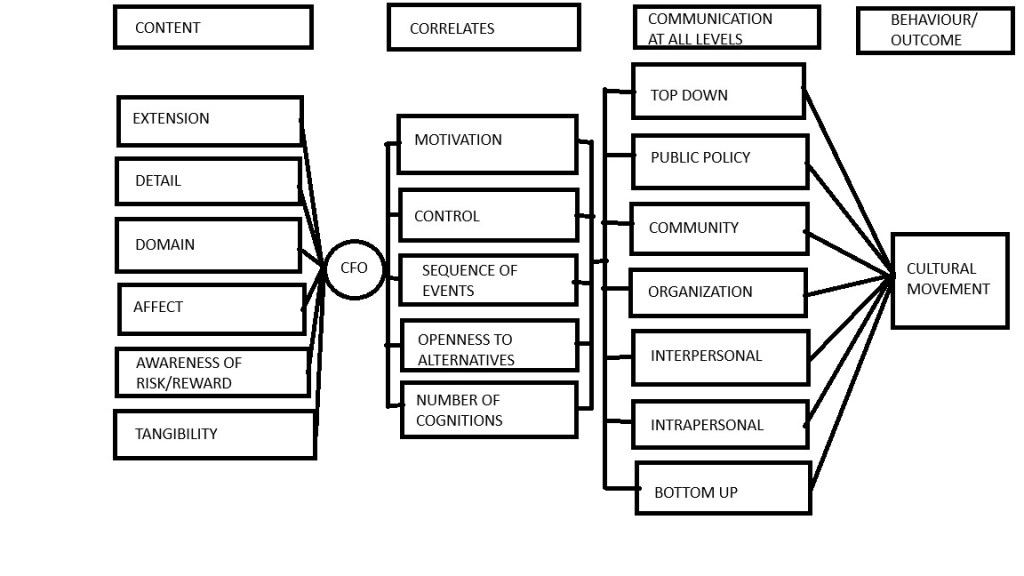
Cultural future orientation integrates the element of openness to alternatives from future consciousness and a new element of tangibility is added to the process. Communication at all levels is modelled on the social ecological model (with top-down from public policy down to intrapersonal scales and a grass roots “bottom-up” process (Mcleroy et al. 1988). Tangible hopes and fears, or the valency of the affect component in culturalist future orientation, can be a powerful motivator to realign values and expectations to reach satisfactory outcomes.
The first two columns of the model will be explained one at a time in relation to the introduction of food hubs worldwide.
Extension: This describes the timeframe of the objective at hand. Future orientation is about imagining a future goal and then taking steps to create the change. There are some timeframes out there about reductions of greenhouse gases by a certain amount, by a certain year. Such as the Paris agreement or net zero policies, which tend to range from 2040 to 2055. A more recent timeframe was provided by the IPCC special 1.5 report (2018) which stated that globally, we would require a 45% reduction in greenhouse gas emissions by 2030. Many people, including myself, argued that this timeframe for such an action is not aggressive enough. This was due to factors in IPCC reporting which inadequately capture the issue at the time of publishing due to exclusion of feedback loop factors (due to unpredictability) and using 3 year old data to generalise predictions. So, given the uncertainty about timeframes I will leave this open to interpretation, but that we do need largescale changes as we approach 2030 and beyond.
Detail: This describes how changes may come about. In the case of food hubs this means funding for the project, locations to install hubs, logistics of food supply chains for the hubs etc.
Domain: This describes the area of influence the changes would impact. So this includes food supply chains, diet transitions, changes to personal routines etc.
Affect: Affect means the valency of an emotion such as positive (hopes) or negative (fears). So if there was enthusiasm for a safer food distribution method with added benefits it brings to dealing with climate extremes, this would be hopes. Fears would be the fear of lack of access to staple foods and social unrest due to this, which can cause lawlessness and looting. The fear of devastating effects on our food chain supply due to climate change should warrant the desire of a more robust and secure food distribution scheme.
Awareness of risks/rewards: This is similar to affect. But this is about the getting the best and most accurate sources of data about risks of climate to the population communicated effectively to everyone. Rewards in this instance would be protection of food supply and general safety of society.
Tangibility: This is the component that I personally added to the future orientation model. I think it takes a certain amount of impact to a person or in this case, society, for them to recognise the risk is real and happening all around them. The greater the number of people who experience climate change related incidents, the greater the desire for action to be taken. This is really starting to increase now in the 2020s with huge numbers of record breaking floods, wildfires, droughts, maximum temperatures and other impacts. These are generally felt in a small section of society at a time. But when these dangers begin causing multinational negative effects, the whole population of a nation can recognise that we must act strongly and expediently.
Motivation: The main motivation for building food hubs is generally not one of desire but necessity. People can recognise that as the climate system rocks us back and forth between extremes, we need to safeguard what is most important, which, second to water, is food.
Control: The public, particularly western nations, currently has control over what they choose to eat and where and when. Governments have control over how much food is imported and the support they give to farmers through subsidies. With the introduction of food halls we become more restricted in what foods we eat but we have exerted our will to ensure everyone has enough to eat. Governments would have control of overseeing the project, its logistics and responding to supply and demand of the hubs.
Sequence of events: This constitutes a detailed plan to invest in and build these food hubs in the places where they are needed. The first thing to be done is to persuade ourselves and then politicians that this is necessary. It could start with pilot projects to see how the systems work together.
Openness to alternatives: This is another feature I added to the CFO, which was borrowed from future consciousness. This factor is about introducing a new method of food distribution to society and how receptive they are to using it. It primarily is there as a safety net in case of severe food shocks but it would hopefully be viewed as an affordable and convenient method to eating out. This transition would see a move away from fast foods as in times of scarcity the priority for food stuffs would go to the hubs and less so to the conglomerate food chains which would become overly expensive during such times anyway.
Number of cognitions: The final element of CFO describes how well thought out the plan is. It includes the thoughts of the public recognising that climate change is a threat to society and one’s own personal safety. Then the amount of thought given to the project to maximise its potential and avoid pitfalls associated with the rollout of hubs worldwide. The more thought the goes into the plan, the more successful it will be.
Then a large component of CFO is communication, which must occur at all levels to successfully install the food hubs. So this is grass roots intrapersonal, interpersonal, organizational, community and top down public policy. The latter being the most important in getting the food hubs project in motion.
What can you do to bring about change?
To get the change needed requires political will. In the UK you can write to your local MP who may bring it up in parliament. You could write to the green party and get them to include these changes as part of their manifesto. Another option is to make a petition on GOV.org, which if it gets signed by over 100 thousand people it must be brought up in parliament. In other countries you can write to any person in political life such as governors, senators, mayors and councils.
Conclusion:
The future climate conditions are unpredictable and food shocks can happen at anytime due to various factors. Using food hubs to manage food security in a controlled and measured manner could save many lives and prevent societal breakdown. The world is now on the cusp of transition. On one hand it could transition into an advanced civilization which controls what needs to be controlled and navigate climate change with care. On the other hand is the threat to the fabric of society which could unravel under pressure from the climate. Believe you can do this and be open to alternatives, which is the gateway to safety.
To read some of my other articles which I have partly borrowed from, click these links:
On an unrelated note – an extension to my theory of physics:
As a side note here, I would like to make an addition to my theory of physics since I no longer have access to that blog. This idea seems obvious but it came to me long after I published my original theory (please excuse the many typos):
I propose that electrons are ring like shaped. This makes sense in my theory because in an incandescent lightbulb, when electricity is passed through a metal filament, the vibrations of the electrons create photons of light. In my original theory I understood that the rapid back and forth motion of electrons caused the formation of a rift or hole in space which then became a photon of a swirling vortex of space, around and through a toroidal shaped 2D surface , which creates its own timefield of moving space. This snapping back and forth punches the hole in space and if the electron is ring shaped, this makes the creation of pockets in space (the precursor of a photon) more clearly understood.
Thats it from me. Dont believe the bullshit.. think for yourselves.
 The Planetarian mode of civilization allows sustainability